%20(2).png)
The Azure Altar: Secrets of the Georgian Tablecloth

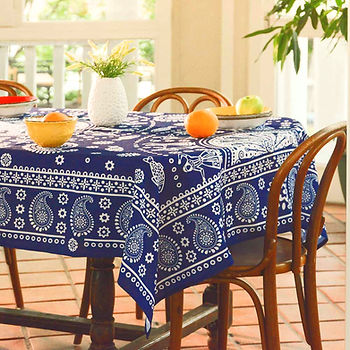
The Lurji Supra (ლურჯი სუფრა), often translated as the Georgian Blue Tablecloth, is one of the most distinctive and symbolically charged textiles of the South Caucasus. More than a decorative house hold object, it functions as a ritual surface, a cultural code, and a mediator between the material and spiritual worlds.
In Georgian tradition, the table is not merely a place for eating, and the tablecloth is not merely fabric. Together, they form an altar of hospitality, memory, and sacred order.
To understand the Lurji Supra is to understand how Georgians perceive space, time, and community. When the blue cloth is spread across the table, everyday life is suspended. The table becomes a structured universe governed by rules of speech, respect, hierarchy, and blessing. Food, wine, and words acquire ritual weight, and the tablecloth itself absorbs this meaning, becoming a silent witness to generations of feasts, toasts, and transitions.
Historical Origins: Between Silk Road Trade and Local Knowledge
Contrary to romanticized claims of prehistoric indigo tablecloths, there is no reliable evidence that the Lurji Supra existed in its recognizable form before the early modern period. While textile production in Georgia is attested archaeologically from antiquity—through loom weights, spindle whorls, and dyed fibers—these finds do not allow us to reconstruct specific printed or resist-dyed tablecloths from before the Common Era.
What we can state with confidence is that Georgia possessed a deep textile culture long before the emergence of the Lurji Supra, providing fertile ground for its later development.
The Lurji Supra as a distinct phenomenon emerged between the 17th and 19th centuries, particularly in eastern Georgia. This period coincided with intensified trade along regional branches of the Silk Road and with Tbilisi’s role as a commercial and cultural crossroads.
Cotton textiles arrived from the south.
Blue dyes entered through Persia, Anatolia, and Indian Ocean networks.
Georgian artisans selectively adapted these influences, creating a textile language that was immediately recognizable and distinctly local. Unlike Ottoman or Persian textiles, which favored dense polychromy, the Georgian Lurji Supra preferred a restrained dual palette: deep blue and white. This aesthetic choice reflected a Georgian taste for visual clarity, symbolic contrast, and legibility.

Indigo vs. Woad: The Truth About the Blue Dye
A critical correction to many popular accounts concerns the source of the blue dye. While imported indigo (Indigofera tinctoria) did reach Georgia, especially in the 18th and 19th centuries, it was not the primary source historically.
In many regions of Georgia, blue dye was traditionally extracted from woad (Latin: Isatis tinctoria; Georgian: მათრახა [matrakha]).
Woad had been cultivated across Europe and the Caucasus for centuries and was well adapted to the Georgian climate. The pigment derived from its leaves produces a blue chemically related to indigo, though often softer and more variable in tone. The use of woad situates the Lurji Supra firmly within local ecological knowledge rather than exotic dependency.
The blue-dyeing workshops, known locally as Lilakhana (derived from lila, the Georgian word for indigo or blueing), were vital hubs of urban craft culture. Within these walls, artisans mastered the difficult chemistry of color. For them, blue was associated with the sky, divine order, and moral restraint. It created a calm visual field upon which the emotional intensity of the Supra (feast) could unfold without chaos.
The Technique of Making Georgian Tablecloth: Resist Printing and Craft Discipline
The Lurji Supra was traditionally produced using a resist-dye technique rather than direct printing.
The Woodblocks: Patterns were carved into blocks made from pear or walnut wood due to their density. These blocks were not tools of improvisation but carriers of tradition.
The Wax Resist: Blocks were coated with a mixture of wax and animal fat, then stamped onto white cotton.
The Cold Vat: The fabric was submerged in a cold dye vat containing fermented woad or indigo.
The Reveal: The cloth was heated to remove the wax, revealing sharp white motifs against a deep blue field.
This negative-print technique produced a distinctive visual effect where white figures appear luminous and immaterial, floating within the blue.
Symbolic Language: Decoding the Cloth
The motifs of the Lurji Supra form a coherent symbolic system. Many designs draw on pre-Christian cosmology later reinterpreted through Christian theology:
Deer: Reference regeneration, solar cycles, and the Tree of Life.
Birds: Act as mediators between earthly and heavenly realms (for example in pre-Christian Georgian tradition).
Fish: Signal Christian faith (Ichthys) and abundance.
Men in Chokha: Figures often dancing or raising cups, affirming the sacred dignity of communal joy.
Cutlery (Knives/Forks): In the 19th century, these borders appeared, reflecting Europeanization and functioning as a performative symbol: the table is set, the feast may begin.
The Table as Altar
In the Georgian worldview, the table is a ritual structure. When the Lurji Supra is spread, it delineates sacred space. The Tamada (toastmaster) assumes a priest-like role, guiding speech and maintaining moral order.
Vertical Axis: Toasts connect the living to God and ancestors.
Horizontal Axis: The community gathered around the cloth.

Food and wine placed upon the Lurji Supra are offerings as much as nourishment. Wine, in particular, holds sacramental status. The tablecloth absorbs spills, symbolically preserving the blessing rather than allowing it to dissipate. Within the blue borders, conflict is prohibited, and strangers become kin. The meal becomes liturgy.
Decline and Modern Revival
During the Soviet period, artisanal dyeing nearly disappeared, replaced by industrial oilcloths. However, from the late 20th century onward, scholars and artists — particularly at the Tbilisi State Academy of Arts — began reconstructing historical techniques.
Old woodblocks were studied, woad dyeing was revived, and the grammar of the Lurji Supra was restored. Today, the Lurji Supra stands as a marker of cultural continuity. Whether hand-dyed or carefully printed, it reasserts the Georgian understanding of the table as a sacred center of life.


Comments