%20(2).png)

WELCOME TO
ARMENIA
ՀԱՅԱՍՏԱՆ
Small country. Timeless civilization. Ancient monasteries, the world's first Christian nation, breathtaking mountain landscapes — and a heritage that has endured for millennia.
Nestled among the rugged peaks of the South Caucasus, Armenia is a land where history is woven into every mountain, monastery, and village. Ancient churches rise above dramatic canyons, vibrant cafés fill the streets of Yerevan, and centuries-old traditions continue to shape everyday life.
Known as the first nation to adopt Christianity as a state religion in 301 AD and home to some of the world's oldest monasteries and archaeological treasures, Armenia offers an extraordinary journey through history, culture, and nature. From the shores of the stunning Lake Sevan and the sacred silhouette of Mount Ararat to UNESCO-listed monasteries, rich cuisine, and heartfelt hospitality, Armenia invites travelers to experience a destination unlike any other—authentic, inspiring, and unforgettable.
Original Name
Հայաստան [hɑjɑsˈtɑn]
Capital City
Area
29,743 km²
Population
3,008,000
Religion
Oriental Orthodox Christianity
Language
Alphabet
Armenia
Armenian alphabet (աբգդէզէըթժիլ...)
Currency
Dram · ֏ · AMD
1 $ ≈ 383 ֏
1 € ≈ 443 ֏
Time Zone
GMT +4
Visa
Many nationalities (EU, US, Canada, UK, etc.) enjoy visa-free entry for up to 180 days per year.

Why Armenia Is Unlike Any Other Country
Some countries you discover gradually. Others force the question from the very first day, differently than you expected. Armenia belongs to the second kind. It is the oldest Christian nation on earth, a country with its own alphabet invented by a single man in a single act of creation, and a land whose principal national symbol — Mount Ararat — does not lie within its borders, but is visible only from the hills of Yerevan, across a closed frontier.
Armenia is a small country in the South Caucasus, wedged between the Black and Caspian seas without touching either. It is a nation of mountains: the average elevation of its territory is around 1,800 metres, and the shift in altitude produces climates ranging from subtropical to alpine within a single day's drive. But what defines Armenia most is not its terrain — it is the depth of its historical memory. Monasteries here are over a thousand years old, the art of the cross-stone (khachkar) is recognised by UNESCO, and the Armenian diaspora scattered across the world outnumbers the population of the country itself several times over.
This guide does not attempt an exhaustive list of sights. Its purpose is to explain what Armenia actually is — its language, its music, its monasteries and its relationship with time — so that by the time you arrive, you already understand a little more than a tourist with a camera.
Armenia was the first state in the world to adopt Christianity as its official religion, in the year 301 — twelve years before the Edict of Milan legalised Christianity in the Roman Empire.
INTERESTING FACT

GEOGRAPHY & REGIONS
A Country on the Roof of the Caucasus
Armenia covers 29,743 km² — roughly half the size of Switzerland. It is also one of the highest countries in the region: about 90% of its territory lies above 1,000 metres. Landlocked, it borders Georgia to the north, Azerbaijan to the east, Iran to the south and Turkey to the west — two of these four borders, with Azerbaijan and Turkey, have been closed for decades.
Armenia's terrain belongs to the Lesser Caucasus and the Armenian Highland: folded mountains, extinct volcanoes, deep gorges and high plateaus. The country's highest point is Mount Aragats (4,090 m), an extinct volcano with four peaks northwest of Yerevan. Its most famous mountain, however — Ararat (5,137 m) — lies on the other side of the border, in Turkey; it is visible from Yerevan on a clear day and remains a national symbol, depicted on the coat of arms of a country it does not belong to.
At the centre of the country, at an elevation of 1,900 metres, lies Lake Sevan — one of the largest high-altitude freshwater lakes in the world and the main summer retreat for Armenians.
Main Travel Sights

Yerevan
One of the world's oldest continuously inhabited cities, famous for its pink tuff architecture, the Cascade complex, brandy heritage and open-air café life beneath Mount Ararat.

Echmiadzin
The spiritual capital of Armenia and seat of the Catholicos, home to what is considered the oldest cathedral in the world.

Garni
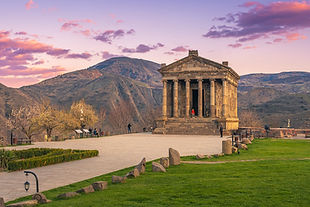
The only standing Greco-Roman colonnaded temple in the Caucasus, perched on a cliff above the Azat River Gorge and the basalt columns of the "Symphony of Stones".

Noravank
A 13th-century monastery set against sheer brick-red cliffs at the end of a narrow gorge.

Sevan Lake
One of the largest high-altitude freshwater lakes in the world, at 1,900 metres above sea level, crowned by the 9th-century Sevanavank Monastery on its peninsula.

Dilijan
A forested mountain town in Armenia's green north, long nicknamed the Armenian Switzerland.

Tatev
A 9th-century monastery on a basalt plateau high above the Vorotan Gorge, reached by the "Wings of Tatev" — the world's longest reversible cable car.

Gyumri
Armenia's second city, built from black tuff, with the country's best-preserved 19th-century streets.

Khor-Virap
Armenia's most iconic viewpoint — a hilltop monastery facing snow-capped Mount Ararat, where St. Gregory the Illuminator was imprisoned before converting Armenia to Christianity.

Areni
The heart of Armenian winemaking, and home to the oldest known winery on earth.

Geghard
A UNESCO-listed medieval monastery partly hewn out of solid rock in the Azat Valley, where chapels, sacred springs and khachkars merge with the cliff itself.

Haghpat
A 10th-century monastery above the Debed canyon, listed by UNESCO together with neighbouring Sanahin.
Map of Travel Sights

HISTORY & ARCHITECTURE
Armenia Through the Times
Most civilizations disappeared with the empires that created them. Armenia outlived them all.
Long before pyramids rose above the Nile, people lived in the caves and fertile valleys of the Armenian Highlands. At Areni, archaeologists uncovered the world's oldest known winery and the oldest preserved leather shoe — silent witnesses to a culture already mastering agriculture, craftsmanship and ritual over 6,000 years ago. From the mighty Kingdom of Urartu to the empire of Tigranes the Great, Armenia became one of the great civilizations of the ancient Near East.
Centuries before most of Europe embraced Christianity, Armenia became the first nation in the world to adopt it as a state religion. It created its own alphabet, preserved an extraordinary literary tradition, and built monasteries that still crown mountain ridges today. While kingdoms rose and fell, monasteries became fortresses of learning, protecting the language, faith and identity of a people scattered across continents.
Standing between the Roman, Persian, Byzantine, Arab, Ottoman and Russian worlds, Armenia rarely enjoyed long periods of peace. Yet every conquest left traces without erasing the nation itself. Empires came and went, borders shifted countless times, but Armenia endured through its culture, its church and the resilience of its people.
The story below follows more than three millennia of Armenian history — from prehistoric settlements and ancient kingdoms to medieval monasteries, merchant cities and the modern republic. It is the story of one of the world's oldest continuously inhabited civilizations, whose heritage continues to shape the Caucasus and inspire visitors from around the globe.
Scroll or tap any moment on the timeline to open it.
Armenia Preserved in Stones
Armenian architecture is the story of a civilization carved in stone. For more than 2,000 years, churches, fortresses, temples and entire villages have risen from volcanic tuff and dark basalt, blending almost seamlessly into the surrounding mountains. From the only surviving Greco-Roman temple in the region to rock-cut monasteries, medieval fortresses and the intricate art of khachkars, Armenia's built heritage reflects one of the world's oldest Christian nations while preserving traces of civilizations far older. To understand it, look beyond individual monuments and discover the architectural traditions that shaped a country built to endure.

LANGUAGE & ALPHABET
An Alphabet Created by One Man
Armenian forms its own, separate branch of the Indo-European language family — it belongs to no other group, though over its history it absorbed loanwords from Persian, Greek, Arabic and Russian. It is spoken by 6 to 7 million people, most of them outside Armenia: the diaspora in Russia, the United States, France and the Middle East outnumbers the population of the country itself several times over.
The Armenian alphabet was created by the monk and scholar Mesrop Mashtots in 405 AD, commissioned by the Armenian Church and king so the people could read the Bible in their own language. It is one of history's rare cases where the alphabet of an entire civilisation has a precise date of creation and a named author. It originally consisted of 36 letters; three more were added later, bringing the modern total to 39.
Armenian Alphabet Day is a public holiday, and monuments to Mesrop Mashtots stand throughout the country — including at the foot of the Matenadaran, Yerevan's repository of ancient manuscripts.
The Matenadaran in Yerevan holds more than 17,000 manuscripts and 30,000 archival documents — one of the world's largest collections of medieval manuscripts, including works of medicine, philosophy and astronomy that had been lost in Europe by the time they were written here.
INTERESTING FACT
Key Words and Phrases
Learning even a few words of Armenian will consistently produce reactions of delight and warmth. Armenians are used to foreigners assuming their language is incomprehensible and not trying. The ones who try stand out in the best way.

MUSIC & DANCE
The Voice of Duduk
No instrument is more closely associated with a country than the duduk is with Armenia. This double-reed woodwind, carved from apricot wood, produces a soft, almost human tone — melancholic, warm and instantly recognisable. In 2005, Armenian duduk music was among the first traditions inscribed on UNESCO's list of Intangible Cultural Heritage.
The instrument's foremost 20th- and 21st-century ambassador was Djivan Gasparyan, whose playing appears in dozens of Hollywood films, from Gladiator to The Last Temptation of Christ. Duduks are traditionally played in pairs: one musician carries the melody while the second holds a continuous drone, a technique called “dam” that creates the instrument's characteristic sense of suspended time.
A separate strand of Armenian music is the sharakan, the centuries-old liturgical chant tradition of the Armenian Apostolic Church, recorded in its own khaz notation system. In the early 20th century, the monk and composer Komitas undertook an enormous project to document Armenian folk music — peasant, wedding and work songs — before he became a victim of the 1915 genocide, surviving it but never recovering from the trauma. Today Komitas is regarded as the founder of Armenian musicology, and Yerevan's conservatory bears his name.
Duduks are made exclusively from apricot wood — believed to be the only material that gives the instrument its characteristic warm, “breathing” tone. The apricot itself is named Prunus armeniaca in Latin — “Armenian plum” — though the tree likely reached Europe via Armenia rather than originating there.
INTERESTING FACT
Songs and Music Worth to Know
Dance
Armenian dance is not something you simply watch. It is something you join. The most famous example is Kochari — a powerful group dance in which dancers link arms or place their hands on each other’s shoulders and move together in precise, rhythmic steps. The movements can be restrained and almost ceremonial at first, then gradually become faster and more energetic. For centuries, Kochari has accompanied weddings, celebrations and important communal gatherings, becoming one of the most recognisable symbols of Armenian cultural identity.
But Armenian dance has many faces. Yarkhushta comes from the mountainous region of Sasun and has a distinctly martial character: traditionally performed by pairs of men, the dancers face each other, advance, retreat and strike their hands together in a ritualised display of strength and courage.
Berd is spectacular in a completely different way. Its name means “fortress”, and the dance is famous for its acrobatic formations — including dancers climbing onto the shoulders of others to create a human tower. What begins as a dance becomes a display of balance, trust and extraordinary physical control.
And then there is Tamzara, a graceful traditional dance performed in a line or circle. Its measured steps and elegant movements create a very different mood from the explosive energy of Yarkhushta or Berd. Together, these dances tell a story about Armenia itself: community, courage, celebration and a deep connection between music and movement. And at an Armenian wedding, there is usually one unwritten rule — sooner or later, you are going to be invited into the circle.

CUISINE
The Taste of Armenia
Armenian food is not complicated. It is generous, slow, smoky and made for sharing.
The table is at the heart of Armenian life. Meat is cooked over fire, bread is baked against the walls of a tonir, herbs appear everywhere, and almost every meal becomes an excuse to sit a little longer and pour another glass.

MOUNTAINS & TREKKING
Wild Armenia
Armenia may be small on the map, but its landscapes are anything but. Much of the country lies at considerable altitude, shaped by the Armenian Highland and the Lesser Caucasus into a world of volcanic peaks, vast plateaus, deep river gorges, alpine meadows and dense mountain forests. Distances are short, but the scenery changes constantly.
This is one of the pleasures of travelling through Armenia: the mountains are not a distant backdrop. They are part of everyday life. Roads wind through high passes, villages sit in valleys beneath enormous ridges, and medieval monasteries appear in places that seem deliberately chosen for their views. A hike can lead to a ruined fortress, a hidden church, a waterfall, a remote village or simply a ridge where the entire landscape opens up below you.
And Armenia offers hiking at almost every level. There are easy walks through the forests of Tavush and around Lake Sevan, longer mountain trails in the Lesser Caucasus, and demanding high-altitude routes on volcanic peaks such as Aragats. The best time for serious trekking is generally from late spring through early autumn, while the higher mountains remain snow-covered well into the warmer months.
What makes the Armenian landscape particularly rewarding is the combination of nature and history. You rarely walk only for the view. Along the way, you may encounter a monastery that is more than a thousand years old, the remains of an ancient settlement, a medieval bridge or a village where the same mountain traditions have survived for generations.
From the volcanic slopes of Aragats to the forests of Dilijan, the spectacular gorges of Syunik and the high waters of Lake Sevan, each region offers a completely different side of Armenia.

Signature Tours

from €697
Armenia’s wild nature, with its rugged canyons, ancient paths, and open-sky freedom — a bold mix of raw landscapes, deep history, and true off-road spirit.
Duration:
6 days
from €787
Majestic Armenia, with its soaring peaks, dramatic canyons and vibrant culture, ancient traditions, warm people and rich cuisine.
A journey you’ll never forget.
Duration:
7 days

from €1290
Discover Georgia & Armenia in 12 days this season — explore ancient monasteries, stunning Caucasus landscapes, vibrant cities, and rich food and wine traditions.
Duration:
12 days


