%20(2).png)
Ararat: the Mountain of Discord


Few mountains in the world hold as much meaning for a nation as Mount Ararat does for Armenians. Rising majestically with its twin peaks, Greater Ararat (5,137 meters) and Lesser Ararat (3,896 meters), this iconic giant is more than just a geographical landmark. It is a living symbol that carries centuries of history, legend, and longing. Its image has been etched into ancient manuscripts, sung about in folk ballads, painted on the walls of churches, and whispered about in exile. For Armenians, Ararat is not just a mountain of stone and snow—it is a mountain of memory.

According to the Book of Genesis, Noah’s Ark came to rest upon the “mountains of Ararat” after the great flood. This biblical association elevated the peak into sacred geography, connecting it to the rebirth of humankind. But for Armenians, its significance stretches beyond religion. Ancient Armenian kingdoms saw Ararat as the seat of their gods, a holy presence that watched over their lands. Medieval artists filled manuscripts with depictions of its twin summits, crowning them with divine light. Through war, displacement, and diaspora, Ararat endured as the silent witness to the nation’s joys and tragedies, carrying the weight of Armenian identity on its snowy shoulders.
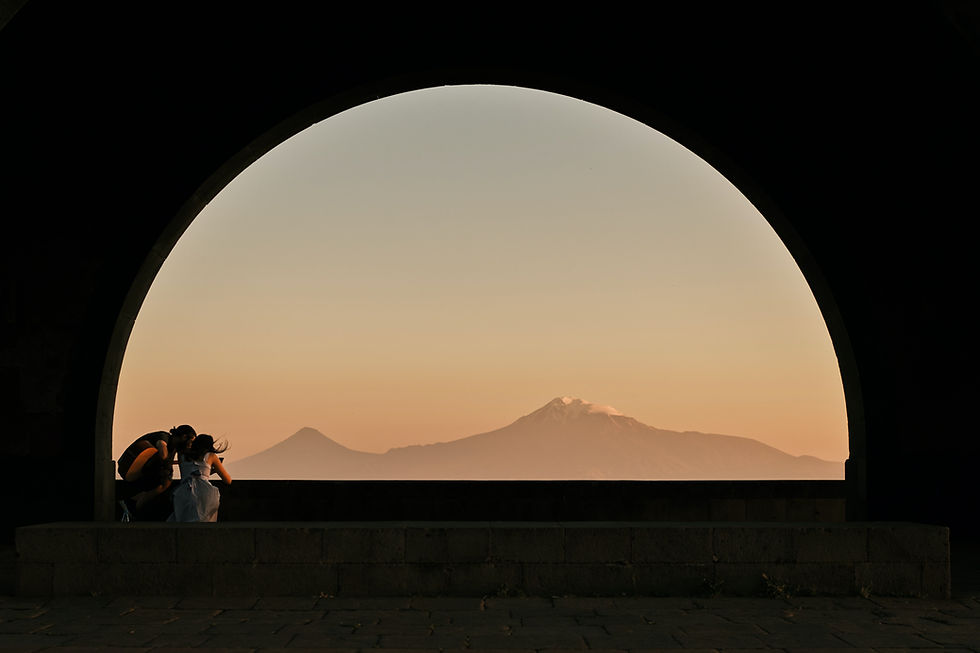
Each dawn in Yerevan, the Armenian capital, the sun gilds the peaks of Ararat. On clear days, the mountain looms over the city, serene yet unreachable. This paradox—that the holiest Armenian mountain stands just across the border in Turkey—has shaped the Armenian spirit with both grief and resilience. Armenians live with the knowledge that their most cherished symbol lies outside their grasp, yet its nearness fills their daily lives. Ararat gazes down on Yerevan as if to remind its people that though borders may change, the mountain belongs to them in ways no map can dictate. Its image is proudly displayed on the coat of arms of Armenia, with Noah’s Ark perched upon its summit. It appears again and again in poetry, songs, and art—an eternal presence at the heart of Armenian culture.

The very name Ararat (Արարատ) carries immense weight. It is a popular Armenian first name, given to children as a blessing of strength and endurance. A province southeast of Yerevan bears its name, forever gazing toward the mountain that inspired it. Armenia’s most beloved football club is called FC Ararat Yerevan, rallying fans under the symbol of their ancestral peak. The country’s world-famous brandy, simply called “Ararat,” has carried the mountain’s aura of authenticity across the world. Winston Churchill himself was said to be fond of it, sipping Armenian brandy during moments of global decision-making. In theaters, businesses, and cultural organizations, the name appears constantly, as if to call on the mountain’s timeless endurance.
Yet Ararat’s story is not only Armenian. The mountain has many names, each reflecting the cultures that have lived in its shadow. In Turkish, it is Ağrı Dağı, the “Mountain of Pain,” a name that hints at its ruggedness and the challenges of its slopes. To Azeris, it is tied to the nearby Turkish province of Iğdır and known as Iğdır Dağı, an imposing landmark without the sacred weight it holds for Armenians. Among Kurds, it is revered as Çiyayê Agirî, the “Fiery Mountain,” a place wrapped in legend and struggle, where Kurdish folklore situates tales of resistance and freedom, sometimes also known as Grîdax. These varied names tell the story of a crossroads of civilizations, of a peak that stands at the meeting point of empires, peoples, and faiths.
And yet, for Armenians, Ararat is something more. It is not merely a geographical presence or a folkloric reference—it is the beating heart of their culture, it is the ancient name of one the first proto-Armenian kingdoms, Urartu. For the Armenian diaspora, scattered across the world after the events happened in 1915, Ararat became a memory carried into exile. Families hung paintings and photographs of the mountain in their homes in Paris, Beirut, Los Angeles, and Moscow. For generations who had never set foot in Armenia, the mountain was still home. It was prayer and poetry, longing and promise, a reminder that the homeland was not gone but waiting.
The image of Ararat has also found its way into the symbols of the modern Armenian state. For decades, the country stamped entry visas with the mountain’s image. Every visitor who entered Armenia left with a mark of its eternal guardian pressed into their passport. Yet in recent years, something has shifted. As Armenia and Turkey, after more than a century of hostility and closed borders, began to take cautious steps toward dialogue, the Armenian government quietly removed Ararat from the entry stamp. In its place, a neutral design was chosen, perhaps to avoid provoking Turkish sensitivities. To outsiders, it might have seemed a small administrative detail, but for Armenians it was deeply symbolic. It revealed how strongly the mountain lives in their imagination—so strongly that even its presence on or absence from a stamp can evoke both pride and pain.
The irony of Ararat’s modern status is unavoidable. After World War I, through the treaties of Sevres and later Kars, the land surrounding the mountain was ceded to Turkey. Today, Ararat stands only thirty kilometers from Yerevan—so close it can be seen on most days, yet unreachable to Armenians without crossing a hostile border. This reality has long been a wound in the Armenian national consciousness, fueling both nationalism and nostalgia. The mountain is not only a reminder of what was lost but also of what endures beyond loss.
Perhaps this is the true secret of Ararat’s power: it cannot be contained by politics. Treaties may redraw borders, governments may stamp or unstamp its image, but the mountain itself endures. Whether viewed from Yerevan’s streets, remembered in diaspora homes, printed on a cognac bottle, or sung in a folk ballad, Ararat belongs to the Armenian people in a way no external force can erase. It has stood for thousands of years, watching over kingdoms and empires that have risen and fallen at its feet, and it will continue to rise above them long after today’s disputes fade into history.

As Armenia and Turkey tentatively approach political warmth, new questions emerge. Can reconciliation coexist with memory? Can a nation hold onto its most sacred symbol even as it seeks peace with the neighbor that controls it? The removal of Ararat from the passport stamp may be a small gesture of pragmatism, but it also forces Armenians to reflect on what their mountain means in an era of shifting realities.
Yet one truth remains unshaken: Ararat is more than a mountain. Turks may call it Ağrı, Azeris may know it as Iğdır, Kurds as Çiyayê Agirî, but for Armenians, it will always be Ararat. Eternal, unshakable, and sacred. A mountain that belongs to all who see it, yet above all, to the Armenian heart. It is not only the past but also the promise of the future—a silent reminder that nations, like mountains, endure.


Comments